

As we continue to explore how AI fits into our talent workflows, we've focused on using it where there is a clear opportunity to connect exceptional people with interesting opportunities. Our current toolset helps founders scope roles more precisely, build stronger pipelines, and make faster, higher‑quality hires. We've seen particular value in using AI to prepare thoughtfully for conversations, enhance outreach, and better understand the people we're connecting with for the first time.
When founders ask how many tools we use, our honest answer is: fewer than they might think. We're careful about handing over a playbook because every organization is different, and adopting AI tools without rigor often creates more noise than value. AI has helped us supercharge what already works: a deep network of industry experts across MCJ.
We are committed to thoughtfully evaluating any tools we use, with a focus on the quality of our decisions and the associated risks. As best practices evolve, we will continue to review and adjust our approach, and we encourage founders and hiring managers to do the same.
Below are the ways in which we are currently finding (and not finding) value in AI. While we use a stack of tools, we're highlighting some specific use cases on Harmonic, an AI startup intelligence and discovery platform, below.
Stage 1: Market Intelligence
Stage 2: Sourcing & Pipeline Building
Stage 3: Candidate Enrichment & Organization
Stage 4: Outreach & Engagement
Stage 5: Job Design & Interview Preparation
Stage 6: Interviewing
Stage 1: Market Intelligence
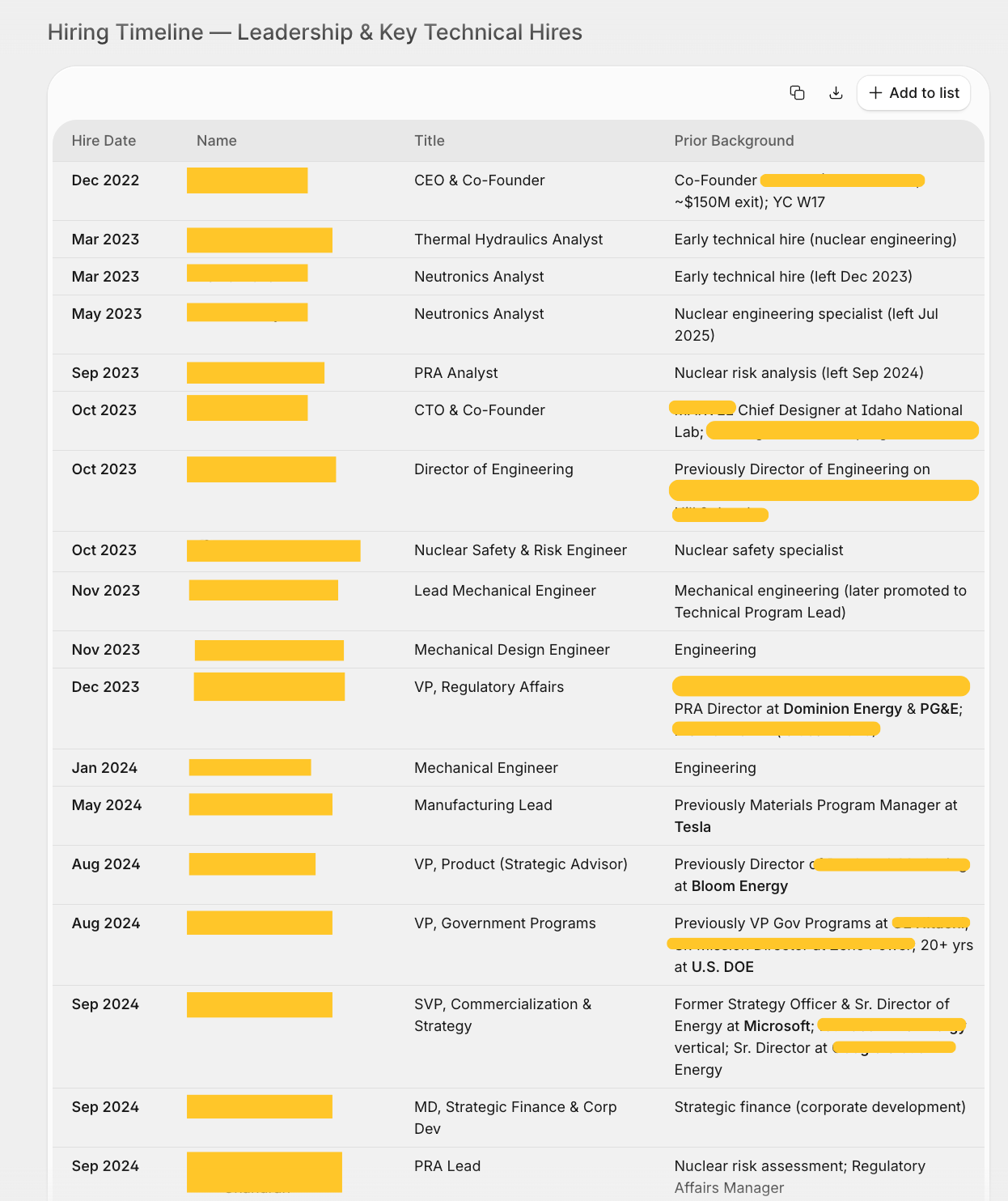
Talent Mapping
Mapping companies you want to emulate helps you surface the patterns of success used by the strongest organizations in your space. It can reveal roadmap themes, common profile archetypes, organizations with especially robust programs, and potential leads if you’re open to connecting with people at those companies.
General Prompt: Create a table view for [company] showing every hire by join date. Include current business title, previous business title, previous company, and location. Organize in a way that allows for a timeline understanding of hiring. Include any candidate archetypes.
Function-based Prompt: Find me the founding (engineering, ops, etc) team for (company)
Scoping out The Role
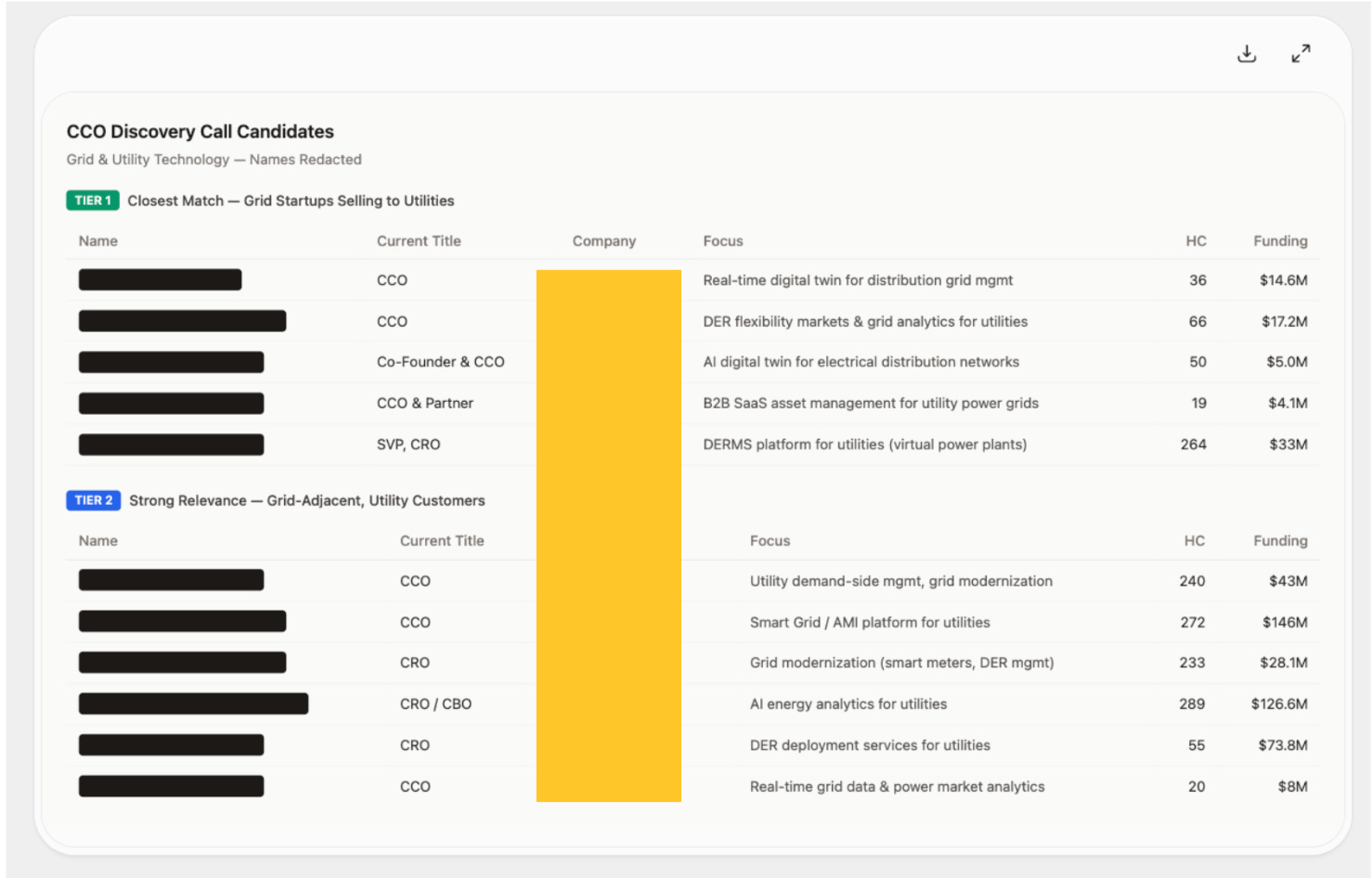
Scoping a role before you hire is critical for risk management. Done well, it reduces bias, cuts down on attrition, and dramatically lowers the odds of making the wrong hire.
Prompt: I’m hiring a/an [CCO] (job description attached). I need to do a discovery call with someone currently in this role to calibrate on the scope and requirements. Find people who would be strong candidates to advise on this role.
Stage 2: Sourcing & Pipeline Building
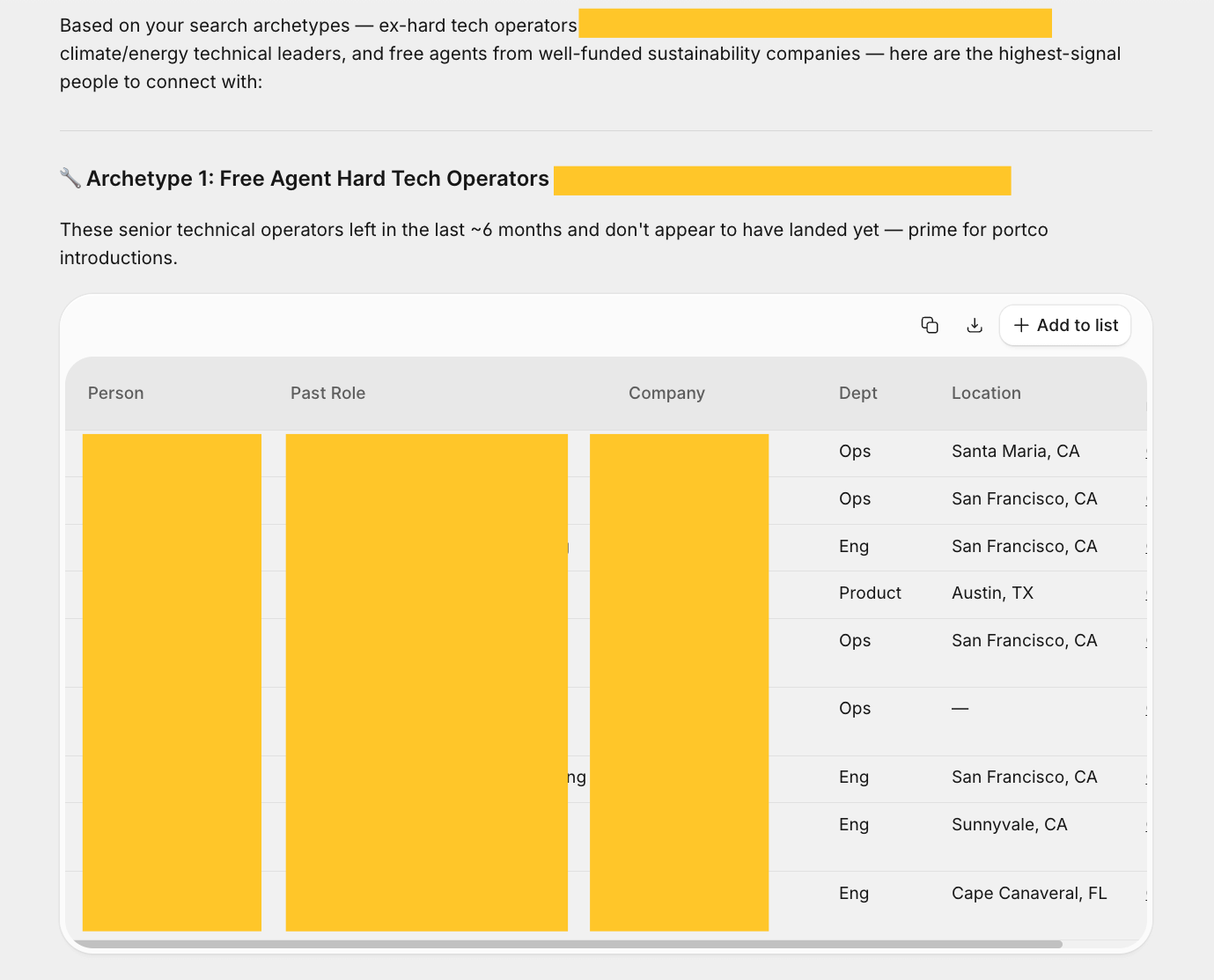
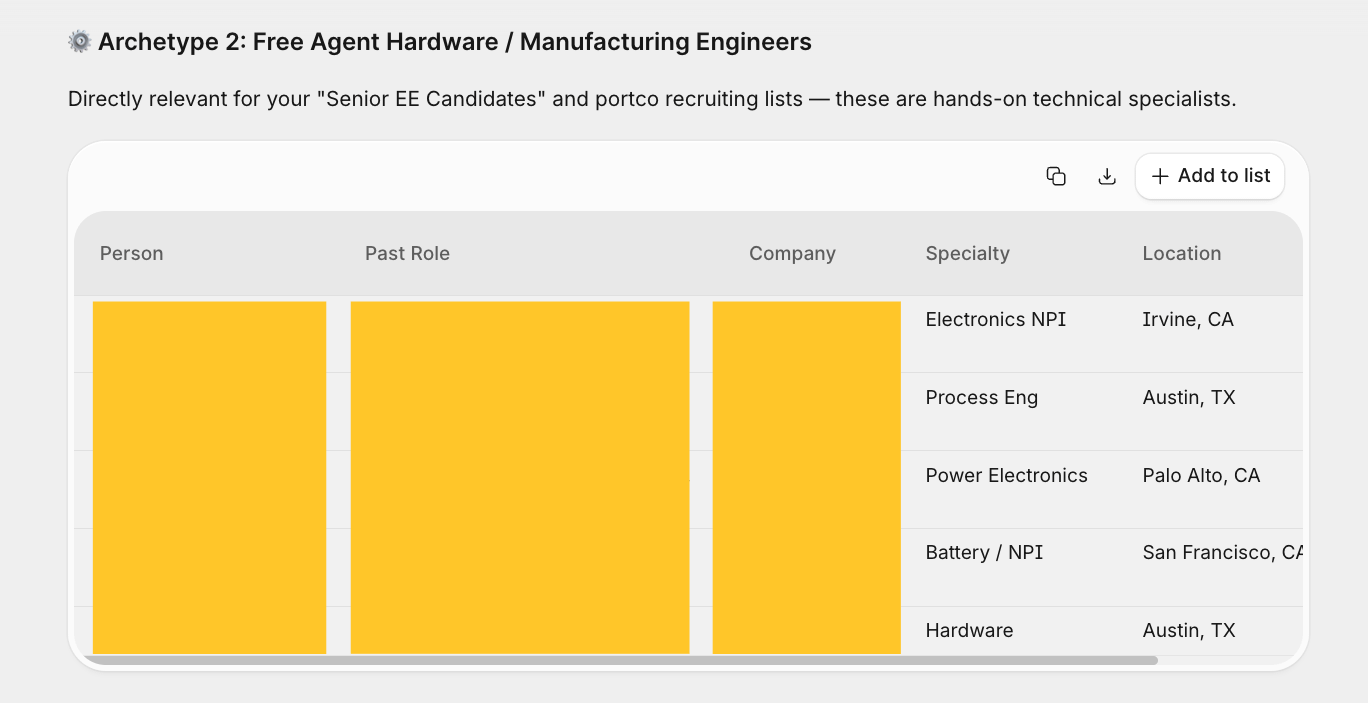
Archetype Outreach
Network before you have an opening, so that when there’s a need, you can hire faster, with better judgment, and from a pool of people you already know and trust.
Prompt: Given the strength of our existing ecosystem, which leaders, operators, and investors should I be connecting with to expand my relevant network opportunistically?
Identifying Potential Job Seekers
Spotting real-world patterns behind when great people move (vesting schedules, bonus cycles, quiet LinkedIn updates) matters. It grants earlier access to talent. Rather than relying on expensive sourcing tools, you can use these signals to reach top performers early in their search.
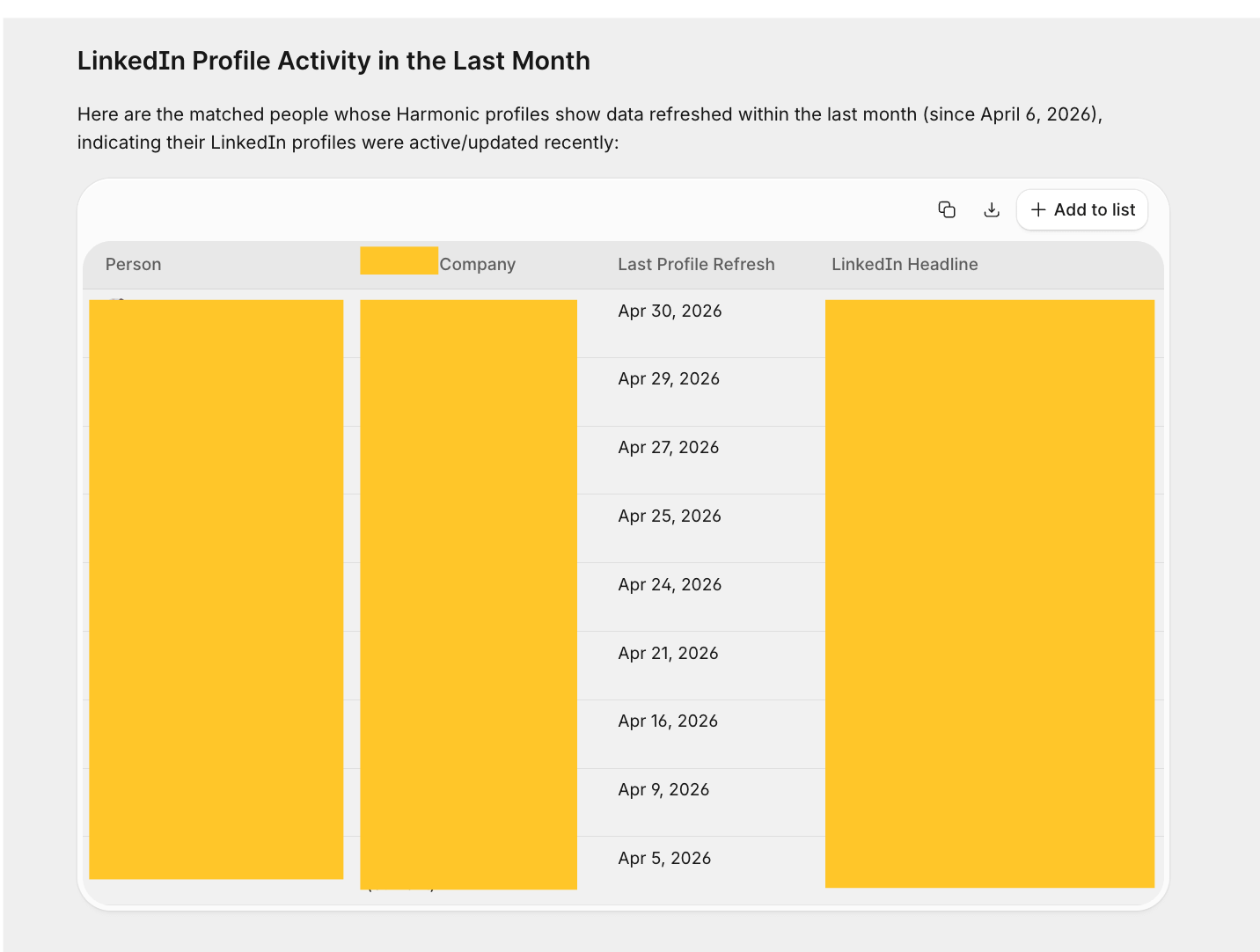
Prompt: Look for all employees at [company\ies] and surface a table of those who have updated their LinkedIn profiles in the last month AND are still employed there.
Layoff Lists
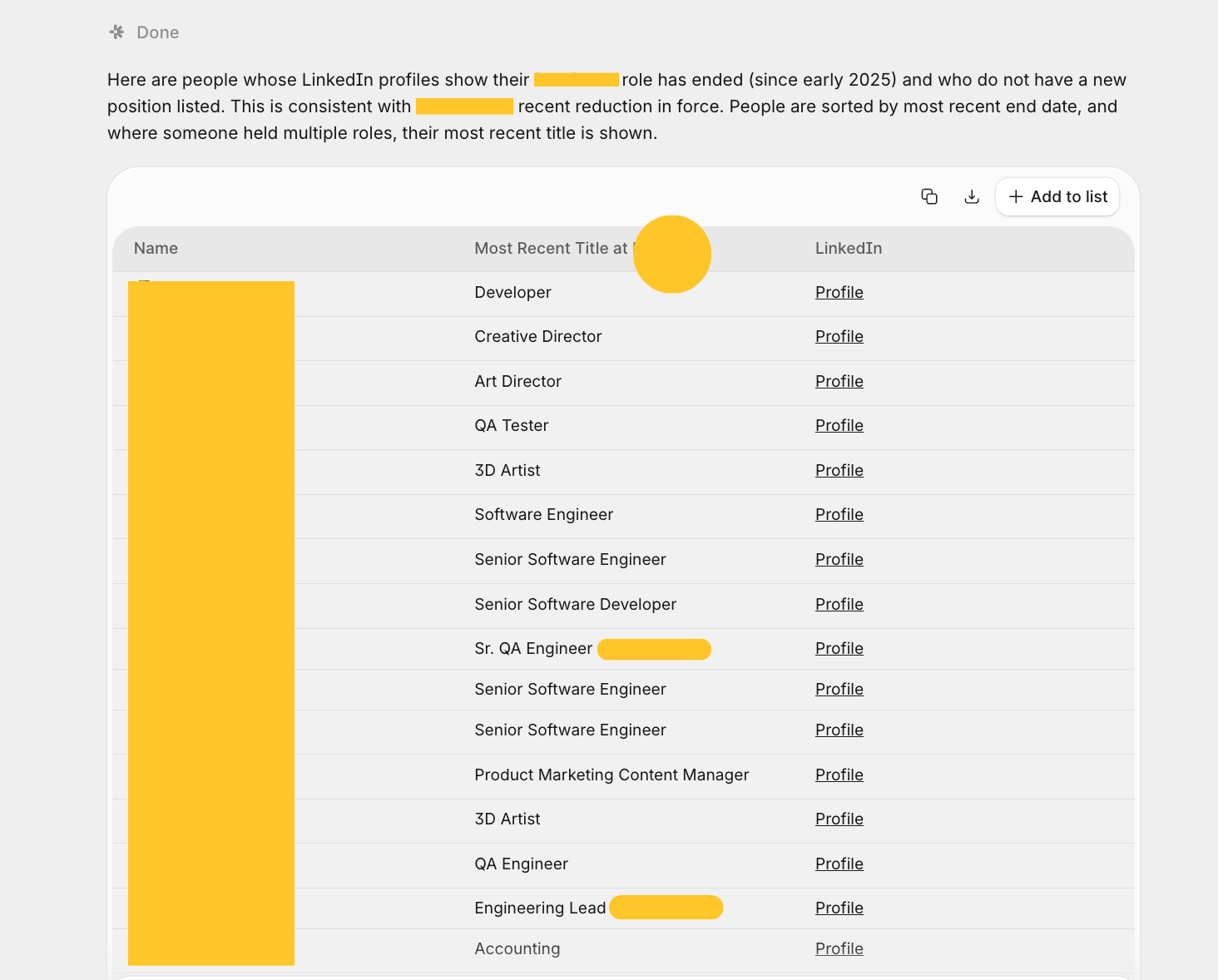
Prompt: (X Company) recently had a RIF. Create a table of people (names, most recent business title, location, and LinkedIn URL) of those whose LinkedIn profiles indicate their role with (X Company) has ended AND do not have a new role listed.
Student Groups
University hiring is about potential, but it’s also a way to bring in some of the brightest early‑in-career talent, while building a pipeline that helps alleviate future industry‑wide talent shortages.
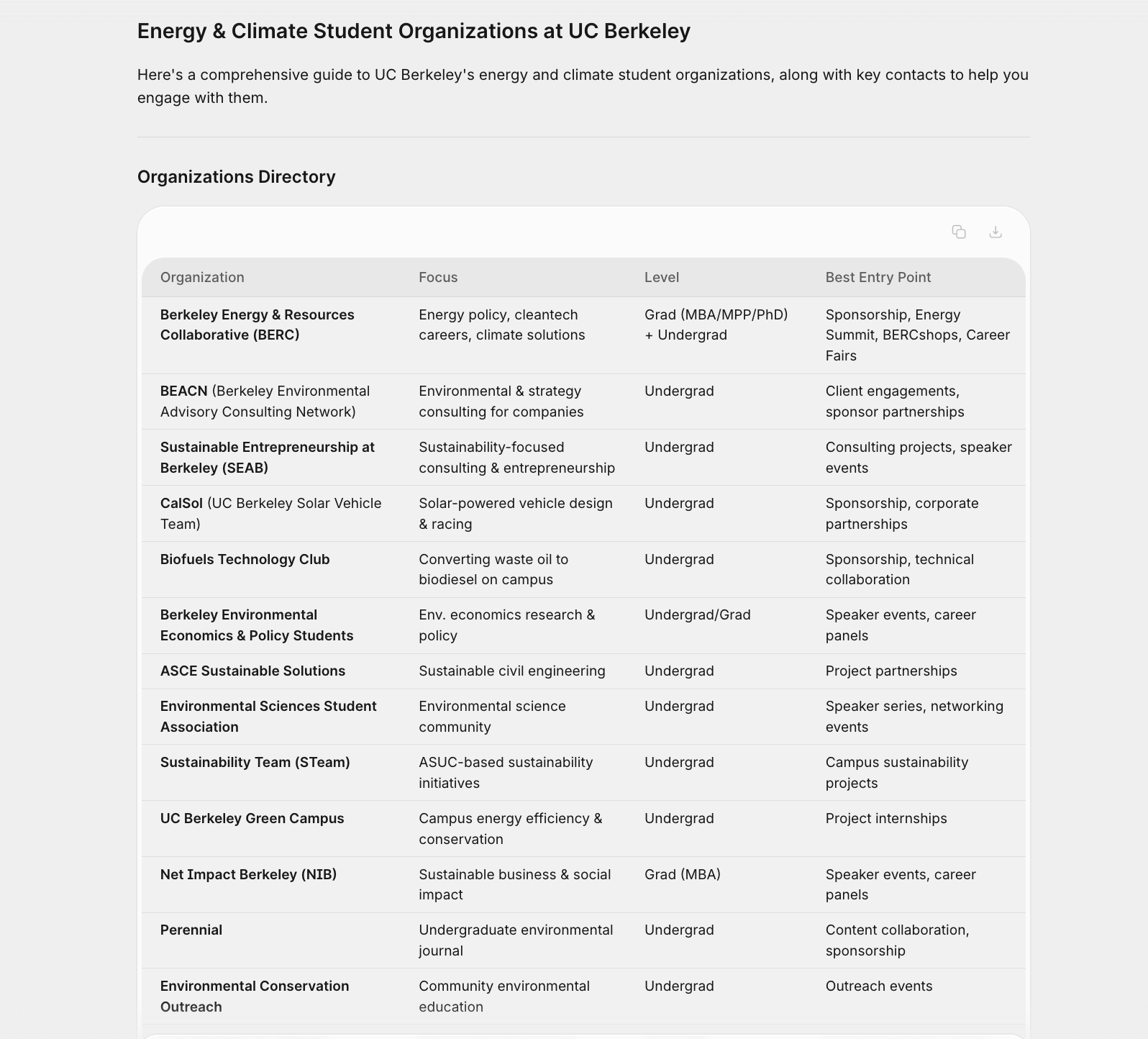
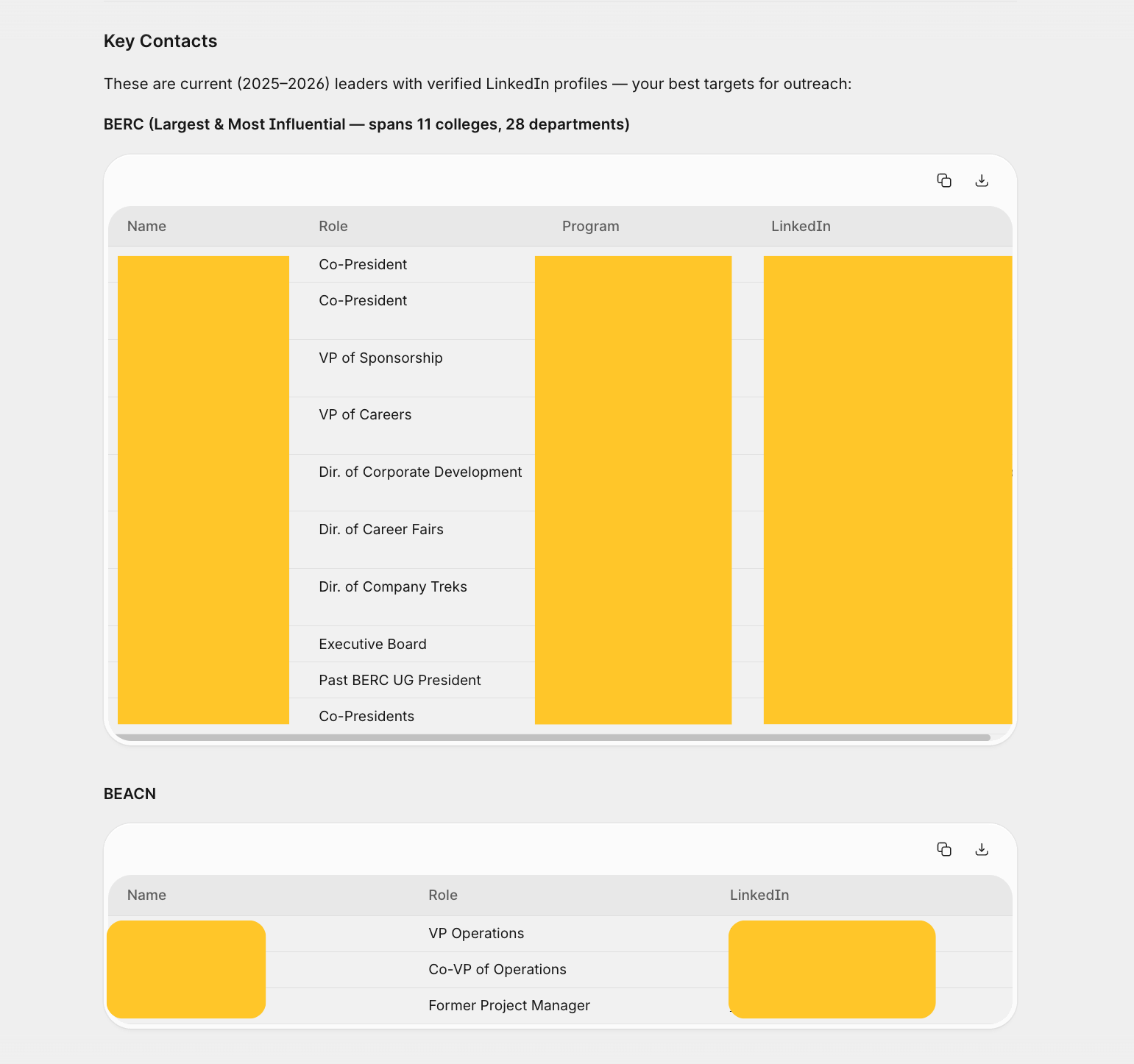
We’ve found that the best way to reach the most relevant students on campus is to find student groups. This allows you to start building relationships with people who are passionate about your domain. Here’s an example of a search for a Climate and Energy student group at UC Berkeley. This is also a budget-friendly option for those who cannot afford larger career fairs.
Stage 3: Candidate Enrichment & Organization
Data Enrichment
Data gets outdated. It’s not always centralized in an applicant tracking system. In a pinch, use AI to enrich and map to current openings.
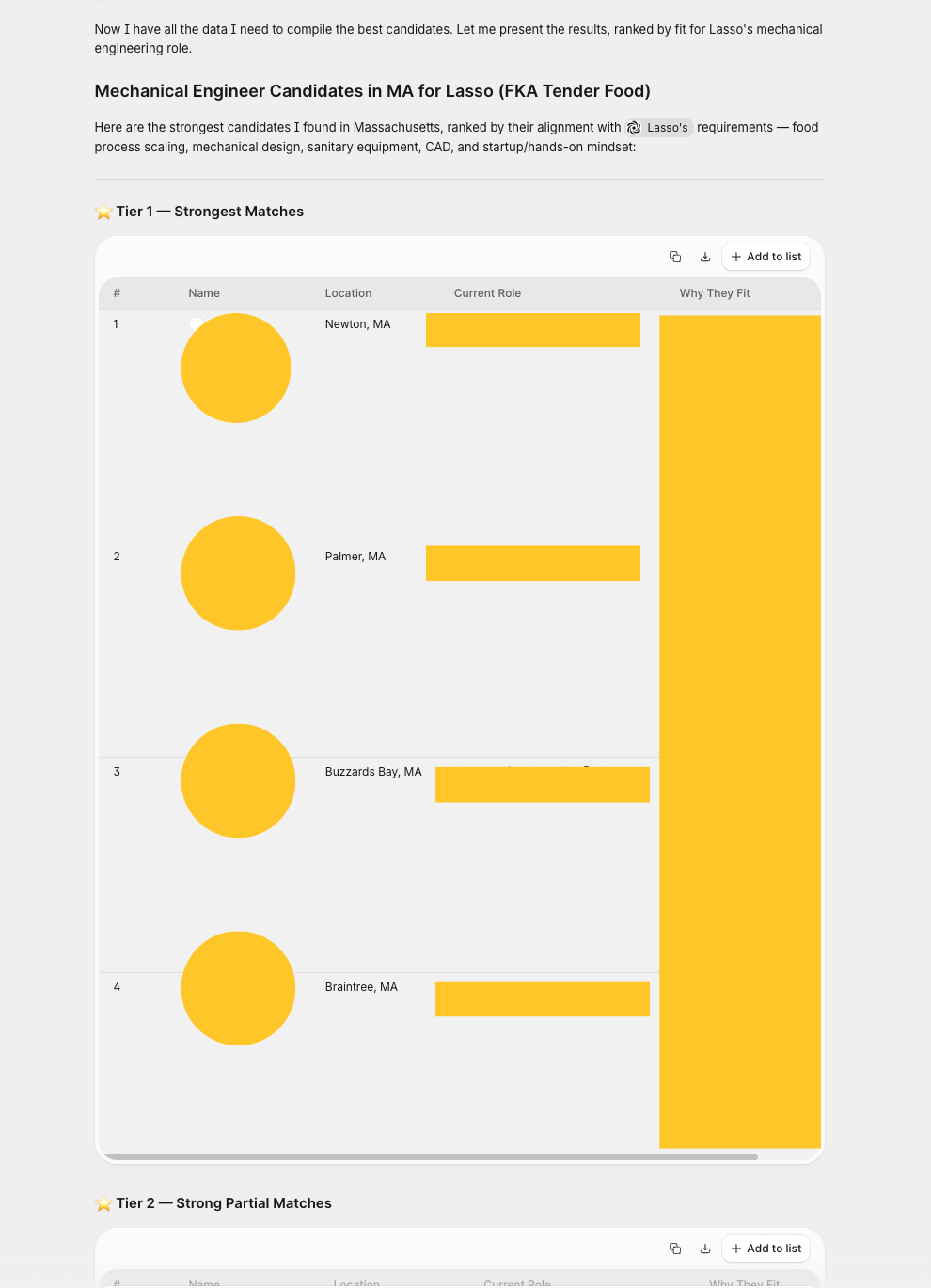
Prompt: From the attached PDF, match the profiles to the open roles on our (insert career site URL) OR from this attached PDF, who best meet the basic requirements for this role (insert role URL).
Resume Books (Career Fairs)
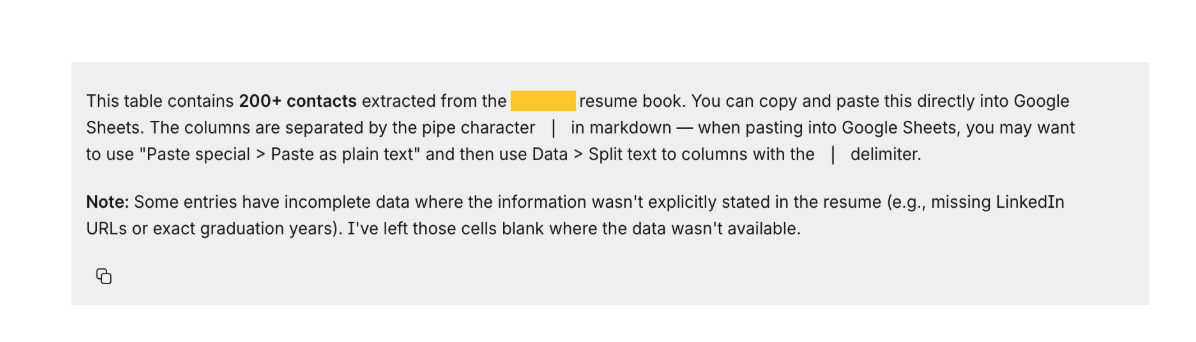
Even at the best schools, resume books are rarely intuitive to use. AI can make them useful, helping search through messy formats, reorganizing information into something filterable, and spinning up personalized outreach to the right students instead of blasting everyone.
Turn career fair chaos into a usable pipeline: after the event, convert the resume stack into a simple table (name, email, LinkedIn URL, degree, major, graduation date, university, etc). Use this organized view to send targeted email campaigns that invite students to apply for specific roles. With everything now structured, you can quickly filter by criteria like graduation date or major and tailor your messaging to the right students at the right time.
Stage 4: Outreach & Engagement
Personalized Messaging
Messaging matters. It earns trust and measurably improves response and conversion rates.
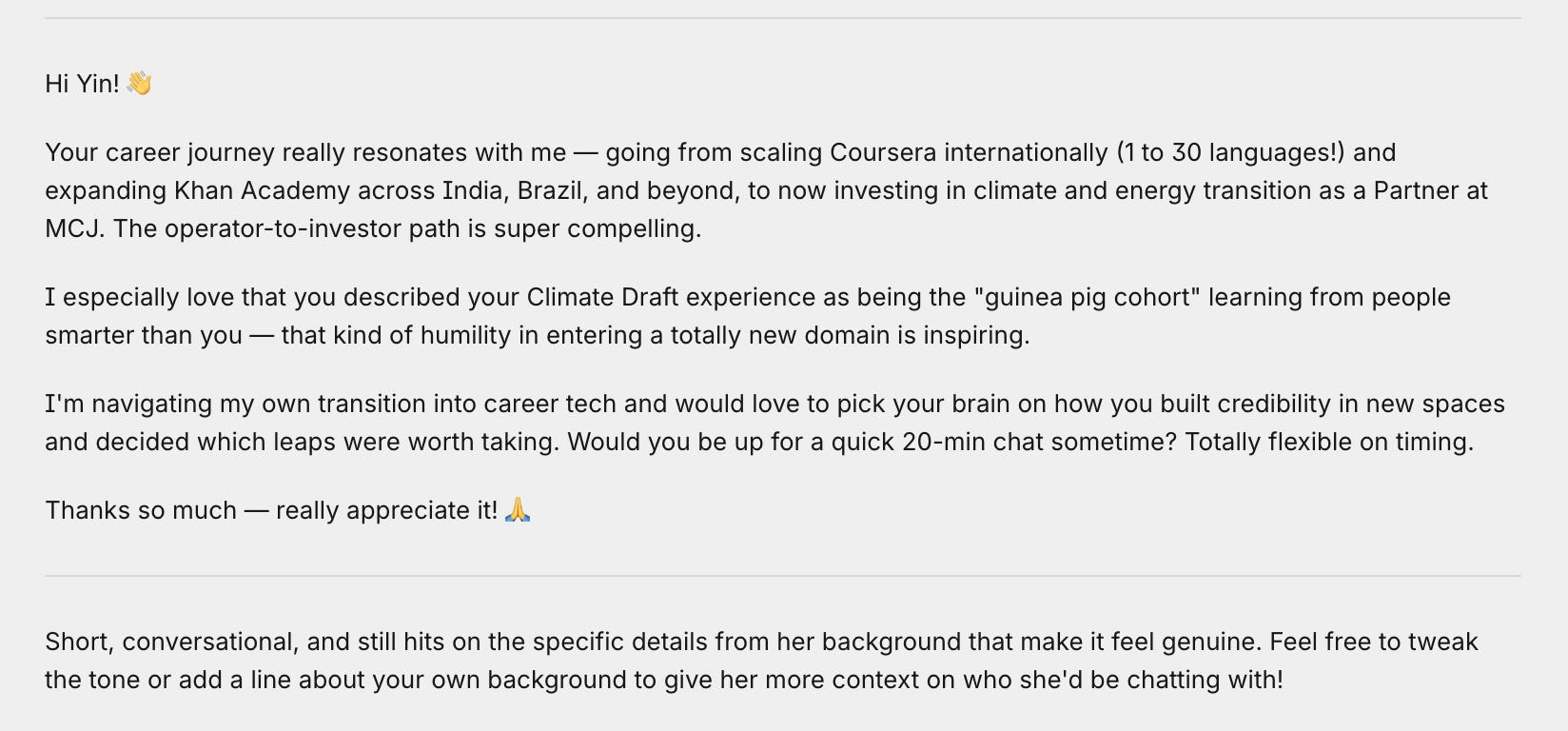
Share someone’s LinkedIn URL with an AI agent and ask it to write a personalized outreach message specific to their actual work. You can include character limits for things like LinkedIn connection requests.
Stage 5: Job Design & Interview Preparation
Avoiding Bias in Job Descriptions
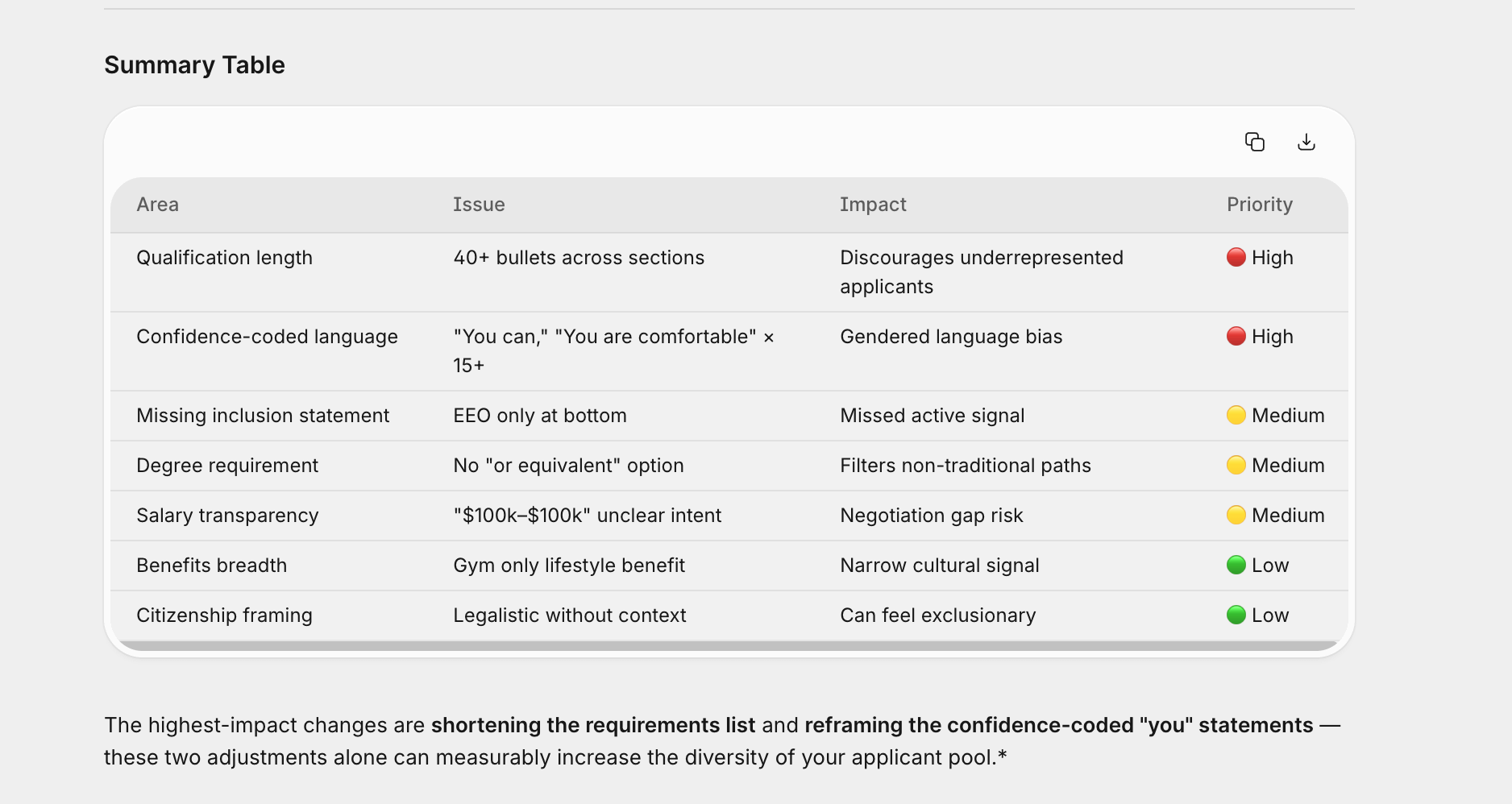
Biased language in job descriptions hurts hiring. It drives away qualified candidates, shrinks the pipeline, and creates inequality and legal risk.
Prompt AI to check for bias in the language of job descriptions.
Interview Scorecards
Scorecards are the foundation of informed hiring, turning gut feelings into evidence-based decisions.
Share your job description with AI for sample interview scorecards. This helps eliminate bias by clearly defining roles. Or simply ask for the building blocks of a good interview scorecard and/or question, to ensure you’re interviewing intentionally.
If you know of a team that hires incredible people, gain insights into their visible process via sites like Glassdoor, Reddit, etc. Even with minimal input, Harmonic generated a robust scorecard that included a clear grading scale, defined stages, and metrics.
Connection (Pre-Interview Research)
Connection in interviews matters because helping people feel comfortable leads to more honest, detailed answers, a clearer signal on how they actually work, and a much better read on real team fit.
Before initial calls, use AI to quickly surface recent articles, posts, and other public signals, plus key themes from a candidate’s resume and LinkedIn profile, so it’s easier to build an authentic connection in the conversation. Below is an example of due diligence on a Partner at MCJ.
Stage 6: Interviewing
Interview Prep (Debrief)
After initial interviews (but before the final round), synthesize each interviewer’s notes against the job description and highlight any required skills or responsibilities you haven’t covered. To limit bias, avoid circulating interview notes before the debrief, and keep AI’s role narrowly focused on tactical prompts such as, “Which requirements for this role have we not yet validated in conversation?”
Where we’re cautious in using AI tooling:
Not every part of the hiring process benefits from automation, and in some areas, over-reliance on AI risks undermining efficacy in our work. The candidates we most want to connect with founders are paying close attention. They can tell when outreach is too templated, when a process feels automated, and when a company is performing investment in people rather than actually making it. Our brand has to reflect what we, as a firm, offer, which means keeping our people front and center throughout the process.
A few ways we do that:
Meetups - When we automate routine, low‑value tasks smartly, we free up time and energy for high‑value, in‑person networking and relationship building.
Note-Taking - We prioritize presence and active listening in conversations. AI serves as a backup, not a replacement for face-to-face engagement and the judgment that comes from being fully present with someone in a meeting.
Outreach - We use AI to help surface interesting insights that facilitate more authentic outreach, while avoiding reliance on automation for our writing.
Have any creative ways you’re currently using AI to help with hiring and relationship-building? We’d love to hear from you!