


Everybody is talking about the strained grid and increased energy usage. And while data centers are certainly an easy scapegoat, buildings account for roughly 40% of U.S. energy consumption. Yet apartment complexes, hospital campuses, and office towers sit largely invisible to the grid, consuming power with no ability to respond to its needs. Addressing building-level energy efficiency could unlock one of the largest untapped levers for grid stability and decarbonization available today.
As Alex Blumberg, CEO and Co-founder of DaisyChain Energy, puts it, the fundamental challenge lies in a complex web of misaligned incentives that undercut progress. In this mismatched network, property owners bear responsibility for carbon footprints they cannot accurately monitor, as residents settle utility invoices for energy usage that building management never actually measures or manages. And the problems don’t end there. Utilities issue retrospective statements that offer no actionable, real-time insights to either party. Navigating this landscape requires re-engineering the underlying economic relationships — enabling clean energy transitions, capturing efficiency gains across existing assets, and unlocking new revenue streams for participants across the value chain.
And that’s why we’re thrilled to announce MCJ’s investment in DaisyChain Energy, a hardware-enabled software platform that transforms commercial buildings by giving their operators real-time visibility into electricity consumption and, by doing so, creates new cash flows that make the economics of decarbonization work from day one. We’re proud to be two-time investors in DaisyChain, supporting their Pre-Seed round in 2024 and their most recent Seed round, where we are the lead investor.
What is DaisyChain?
Most multifamily buildings are directly metered, meaning each tenant has an individual relationship with the utility, and the building itself has no visibility into aggregate consumption. DaisyChain flips this model by converting buildings into a master meter plus sub-metering configuration.
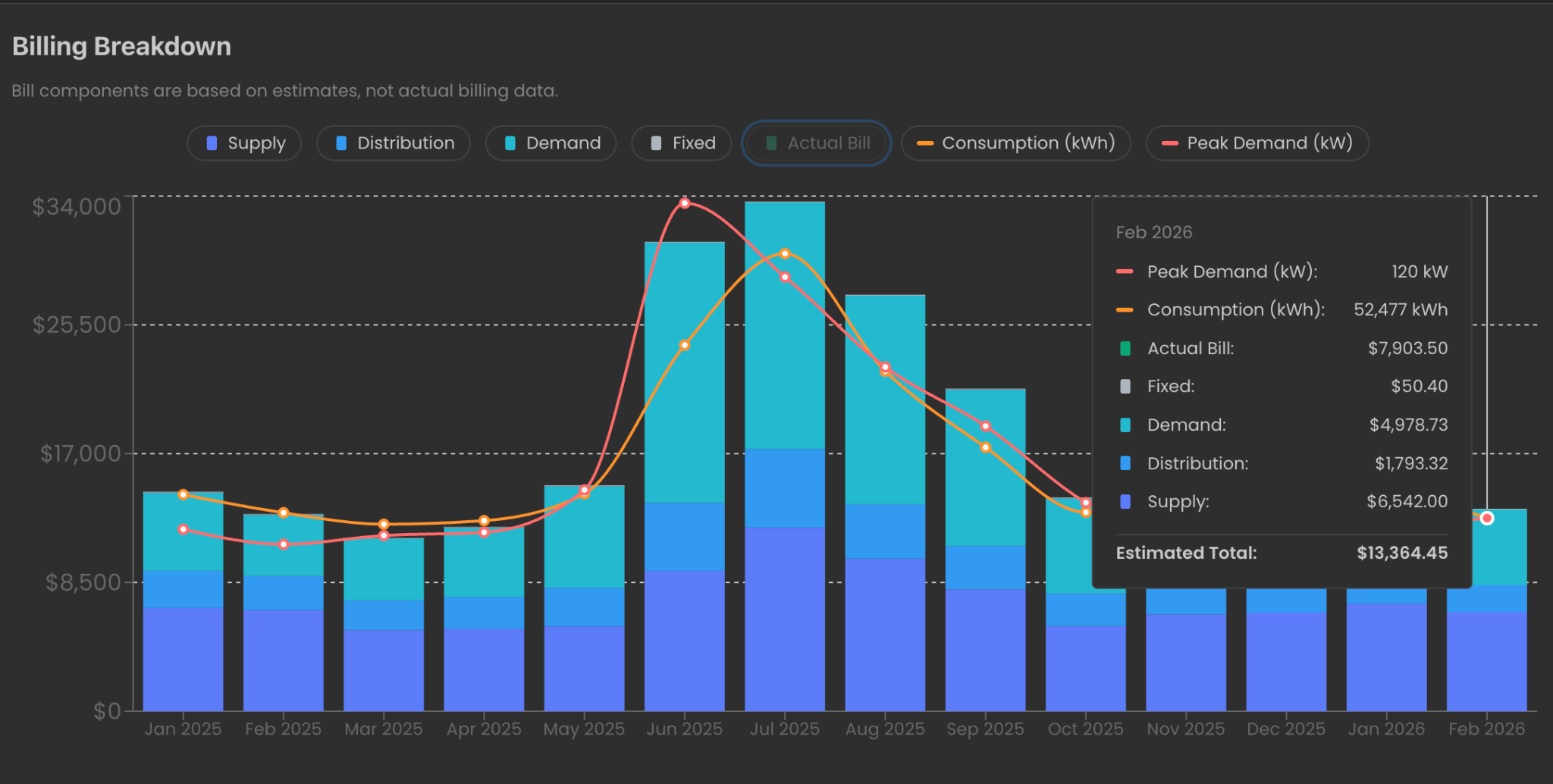
DaisyChain installs its own meters and becomes the intermediary between the building and its residents. Residents pay the same rate as before, but to their building owner instead, who purchases electricity at a lower commercial master meter rate and keeps the spread. That margin is pure new cash flow, a structural rate arbitrage baked into how utilities price different customer classes. DaisyChain handles the billing, monitoring, and compliance – turning what sounds operationally daunting into a straightforward revenue stream.
DaisyChain currently targets two customer segments: multifamily residential buildings and large commercial campuses. The company already manages more than 1,200 units across two dozen buildings and is on track to more than double its footprint this year. Northwell Health, New York’s largest hospital network, illustrates the commercial use case. Northwell’s backup generation systems were triggering without any grid failure, forcing canceled procedures and costing up to a million dollars a day. DaisyChain’s high-resolution meters identified the culprit and gave Northwell the documented evidence needed to address it. Where DaisyChain generates new revenue for multifamily buildings, here it protects existing revenue.
Why We Invested
Submetering is the wedge, but it’s the aggregated load data Daisychain manages that makes its technology valuable over time. Once a building’s consumption is visible, that load becomes an asset that can be optimized and monetized in multiple ways. For example, DaisyChain’s platform actively monitors and shapes load to reduce peaks, both protecting and widening a building’s margins. With aggregated building-wide load under management, DaisyChain can bid curtailable capacity into utility demand response programs, a revenue stream that becomes meaningful at full building scale, and matches the needs of commercial property owners with the needs of the grid to create mutual value. Finally, as EV chargers, batteries, heat pumps, and solar come online, DaisyChain serves as a control layer that optimizes each asset across multiple value streams simultaneously, routing each kilowatt hour to its highest value use. As Alex Blumberg explained in an episode of the Inevitable podcast:
“We’re building the integration and control layer of electrification for the built environment.”
Alex Blumberg is a two-time founder whose first company, Gimlet Media, was acquired by Spotify in 2019. Planet Money, a long-running NPR podcast he co-created, immersed him in economics and provided a unique lens for following the incentives in climate. That instinct led him toward the built environment precisely because its incentive misalignments were so severe and underappreciated by the entrepreneurial community.
Blumberg’s co-founder Mcgowan Southworth’s personal sustainability path is the origin story of the company’s core business model. As president of his Sunset Park co-op in 2011, Mcgowan worked through the regulatory thicket to set up submetering for rooftop solar and discovered the rate arbitrage almost by accident. Additionally, CTO and Co-founder Bob Currie brings technical and operational depth to match. Currie founded Smarter Grid Solutions, a DERMS company he sold to Mitsubishi Electric, giving him deep experience on the utility side.
DaisyChain’s guiding question from day one has been simple: Can we make decarbonization the smart financial choice? Their strong early traction suggests the answer is yes, and we’re proud to back the team as they prove it at scale.
Additional Resources
