

The War of the Currents was fought nearly 150 years ago.
Thomas Edison, Nikola Tesla, and George Westinghouse viciously fought over one essential question: should we power our electric grid with alternating current (AC) or direct current (DC)?
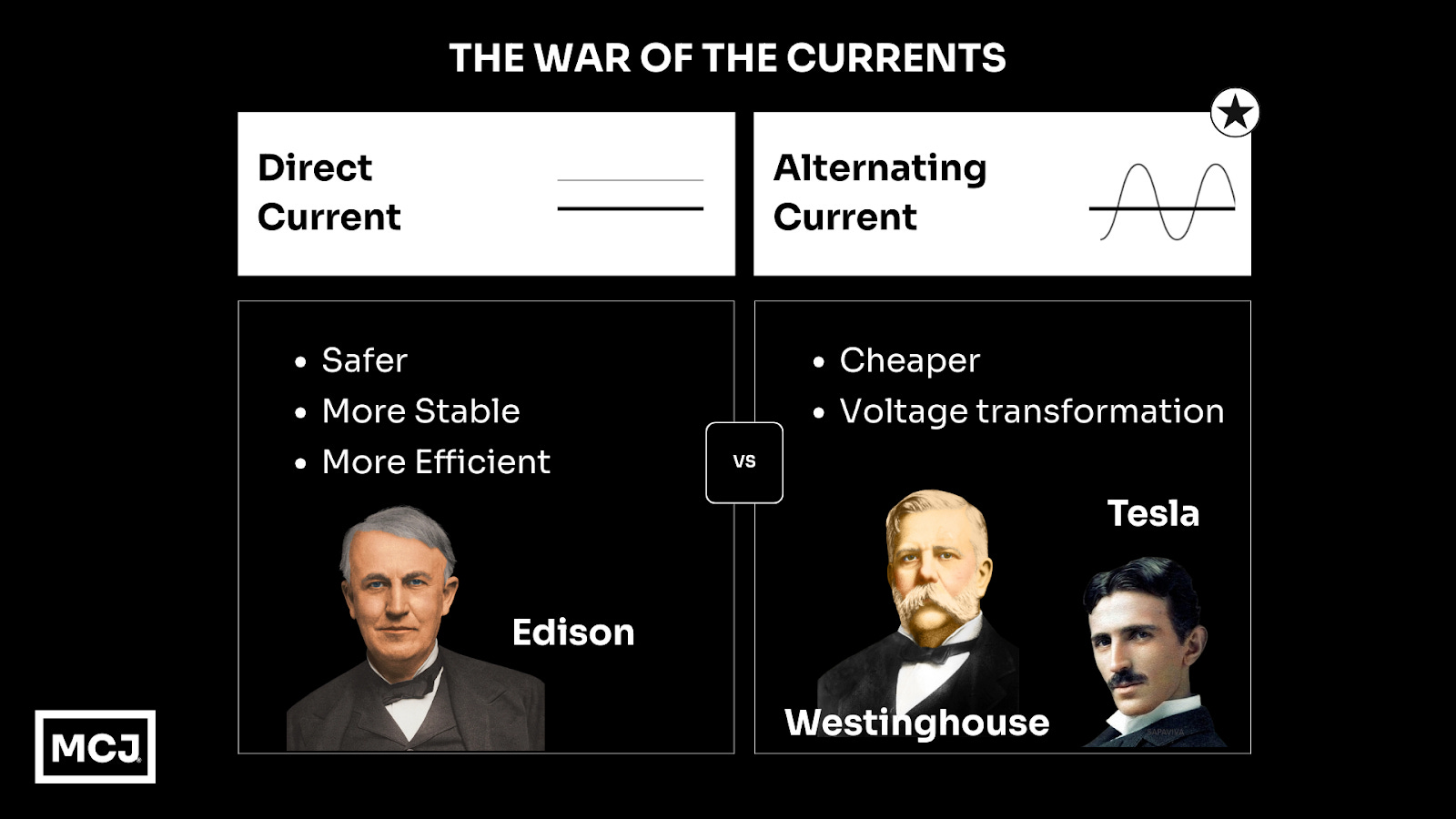
It got gruesome. At one point, Edison began electrocuting animals to show the danger of alternating current.
Ultimately, the war settled for one simple reason: Transformers.
Here’s the logic:
We needed to transfer electricity across long distances.
Stepping up and down voltage was the only efficient way to do so (e.g. changing how much electricity wants to move).
Transformers are the technology to do so.
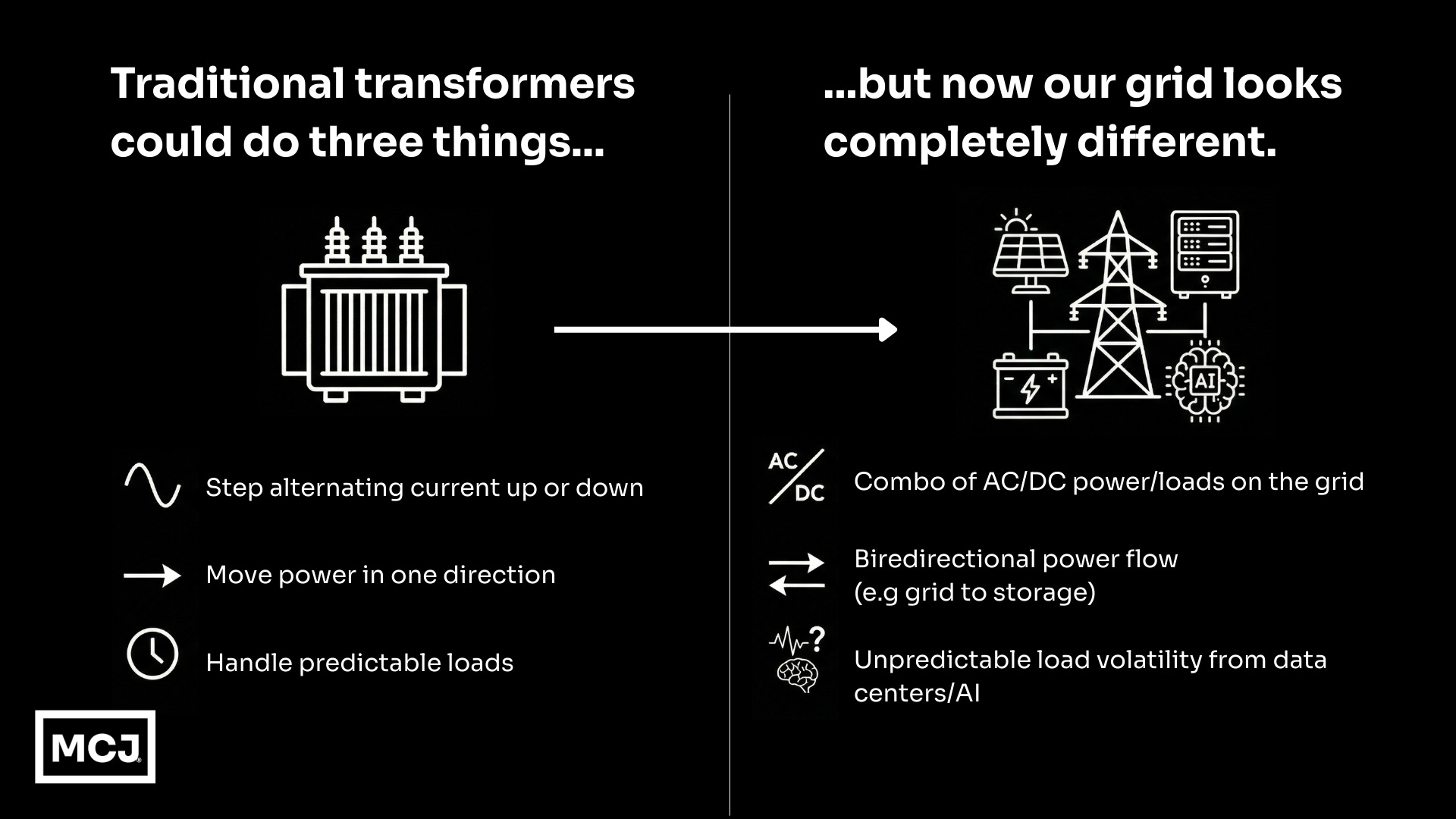
Transformers could only use alternating current.
That’s it. Transformers decided how our electric grid was shaped.
Now, the constraint that shaped the grid is the bottleneck holding it back.
MCJ is proud to back DG Matrix in its $60M Series A, led by Engine Ventures with participation from Clean Energy Ventures, Cerberus Ventures, Chevron Technology Ventures, Fine Structure Ventures, and others. DG Matrix is reinventing the architecture that underpins our electric grid, rethinking how power is converted, routed, and delivered for an increasingly electrified world.
What is DG Matrix?
DG Matrix is building the first multiport solid-state transformer (SST) solution: a programmable power router that can convert AC to DC, DC to AC, step voltage up or down, and dynamically route energy across multiple inputs and outputs.
In other words, a universal adapter for power.
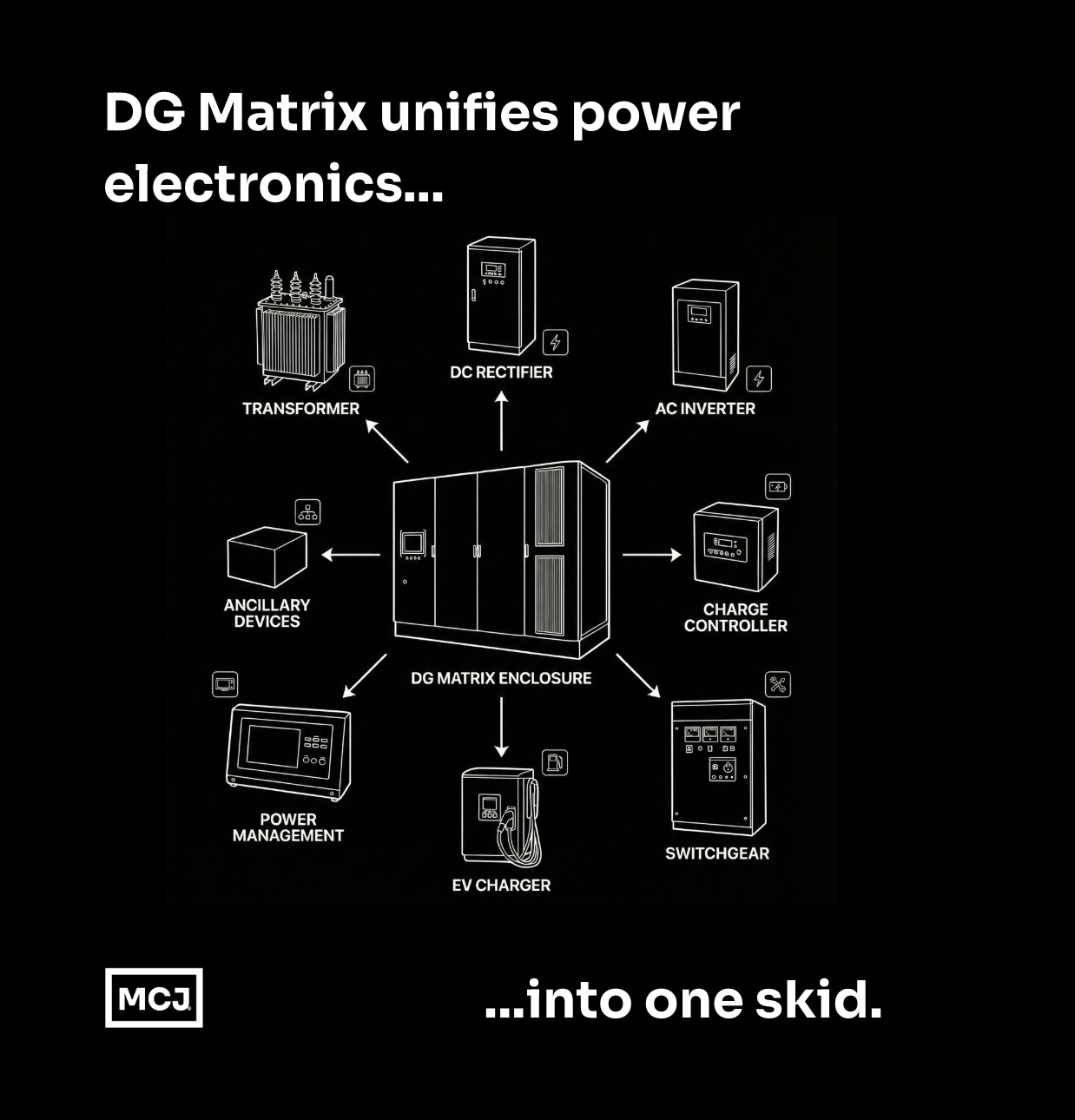
DG Matrix is designed for maximum grid flexibility. Its multiport architecture allows customers to accept disparate power sources at varying voltages and deliver exactly the power configuration they require. Solar, batteries, generators, and the grid can all integrate seamlessly through a single system.
By consolidating all necessary power electronics into one skid, DG Matrix saves customers space and cost. For context, a data center today typically requires transformers, switchgear, rectifiers, inverters, and power protection equipment deployed across multiple skids. In many installations, this power conversion stack spans two 4×30-foot skids. A single DG Matrix Interport replaces this equipment with a 4×4-foot device, combining 10 critical components into one unit with a 15× smaller footprint and up to 90% lower system cost.
DG Matrix was founded in 2022 by CEO Haroon Inam and CTO Dr. Subhashish Bhattacharya in Raleigh, North Carolina. Inam previously served as the CTO of Smart Wires and led the power electronics company to an IPO. Bhattacharya is the leading publisher of low and medium-voltage solid-state transformers in the space.
DG Matrix’s commercial SST will be the first to market, building both a low-voltage solution for microgrids and fleet electrification and a medium voltage for data centers.
Why did we invest?
First, Why Solid-State Transformers?
All infrastructure is built around a single limiting technology. Early factories were organized around a central steam engine, forcing building layouts around their power source. Telecom networks were designed around the limits of copper wiring before fiber optics. Cities historically formed around natural water sources before large-scale water conveyance systems.
The electric grid is no different. It was designed around the capabilities of magnetic-core transformers developed in the late 1800s.
At MCJ, we look for the technologies that lift these constraints. Solid-state transformers allow the grid to modernize beyond its original architecture, unlocking a more flexible, intelligent, and bidirectional power system.
Why DG Matrix?
Building a next-gen power electronics component requires deep transformer R&D experience and past power electronics scaling experience. This means deep manufacturing intuition, utility relationships, and the patience to iterate through certification cycles. Inam has done it before, with 200 patent applications, a team of 24 PhDs, and $40M ramp within the first three months of production at Smart Wires.
Meanwhile, CTO Dr. Subhashish Bhattacharya brings deep technical leadership in power electronics, with more than 800 publications and over 25,000 citations. His work includes the highly cited Voltage and Power Balance Control for a Cascaded H-Bridge Converter-Based Solid-State Transformer (800+ citations), providing the technical foundation needed as DG Matrix expands from low-voltage deployments to medium-voltage systems.
DG Matrix is the only company developing a mature multiport solid-state transformer architecture. They have built both a low-voltage and medium-voltage offering, allowing them to serve applications such as fleet electrification and microgrids while also supporting data center deployments. Over time, we believe the broader electrification of fleets, buildings, and distributed energy systems is likely to be a more durable driver of demand than any single infrastructure cycle.
The company has also begun building relationships with early adopters of solid-state transformer technology, including collaborations with companies such as Exowatt, an MCJ portfolio company.
Where do we go from here?
Working with DG Matrix sharpened our view of the “picks and shovels” bottlenecks across the power stack. We are actively exploring opportunities in core grid components (inverters, substations, and next-generation circuit breakers), particularly where wide-bandgap semiconductors like silicon carbide can unlock major improvements in efficiency, size, and system flexibility. New architectures are already emerging, including NVIDIA’s 800V DC data center design, which challenges long-standing assumptions about how electricity should be delivered.
As a result, we believe power systems are shifting toward DC-native architectures. As solid-state transformers release us from AC infrastructure, we can enable more flexible routing, tighter system control, and better monitoring of energy flows. Projects like Sun Cable’s HVDC link between Australia and Asia illustrate how direct current is already being used to move power more efficiently at scale.
Together, these shifts suggest we are still in the early innings of re-architecting the electric grid. As these constraints fall away, the most valuable opportunities will come from the technologies that make a more flexible, software-defined power system possible.